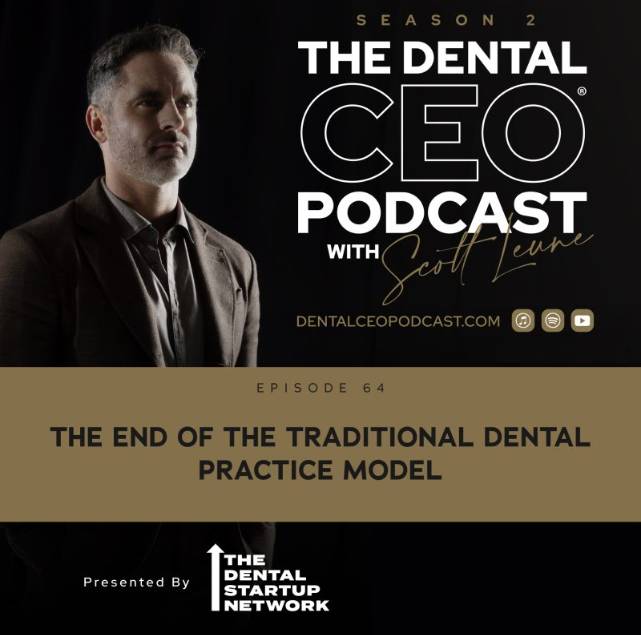
Dental CEO Podcast Episode 66: Your Website Is No Longer Your Biggest Marketing Asset
In this episode of The Dental CEO Podcast, Scott Leune is joined by Bill Donato, Founder of DentalMarketing.com, to break down why your website is no longer the biggest driver of new patient calls. As patient search habits change, Google My Business, local search visibility, reviews, hyperlocal content, and real-time search queries are becoming more important than ever. Scott and Bill explain what dental practice owners need to understand about the new rules of dental SEO and how practices can improve visibility, compete locally, and generate more new patient opportunities.
Highlights
- Breakdown of how AI agents for SEO work and why they outperform traditional human-driven search engine optimization strategies.
- Explanation of why Google My Business is now the single biggest driver of new patient calls — surpassing practice websites and paid ads combined.
- Deep dive into how AI agents discover real-time patient search queries and automatically create hyper-local, guideline-compliant content to boost rankings.
- Real-world results from dental practices using AI-powered SEO, including a small Miami practice that jumped to the #1 map ranking for “dentist in Miami” within weeks.
- Overview of how voice search, Google’s Gemini integration, and large language models are reshaping how patients find dental practices — and what dentists should do now to stay ahead
Speakers

Dr. Scott Leune
Scott Leune, known as The Dental CEO, is one of the most respected voices in dental practice management. From his seminar room alone, he has helped launch over 2,000 dental startups and supported more than 20,000 dentists across practices worldwide. Named one of the 30 Most Influential People in Dentistry, Leune delivers practical, no-fluff strategies that empower dentists to lead with confidence, scale efficiently, and achieve real personal and financial success.

Bill Donato — Founder - dentalmarketing.com
Bill Donato is a co-founder of DentalMarketing.com, a full-service marketing agency dedicated exclusively to dental practices across the U.S. and Canada. With over a decade of dental marketing experience, his team serves roughly 500 practices and offers digital paid media, direct mail, AI-driven SEO, and call analysis, all managed in-house by specialists who understand the dental industry. Bill’s team has developed proprietary AI agents that automate and accelerate SEO and voice AI technology that monitors incoming calls to help practices better understand both their marketing performance and front desk operations
Watch Episode
Read Full Transcript
Scott Leune: If you're a dental practice owner in the US or Canada, I want to talk to you about something that's quietly draining your profit every single month. Credit card fees. Most practices are giving up around 3% of their collections just to get paid. On a million dollar practice, that's about $15,000 a year, just gone. And the worst part is most dentists just accept it as the cost of doing business, but it doesn't have to be that way. That's why I want to introduce you to SignaPay. SignaPay uses a dual pricing model where the patient pays the processing fee if they choose to use a card. That means you collect your full fee, your numbers actually reconcile and that 3% stays in your pocket instead of going to the credit card companies. You're already seeing this everywhere else. Gas stations, restaurants, ticketing, ATMs. So the question is, why aren't we doing this in dentistry?
If you're processing any real volume, this is one of the easiest ways to instantly increase profitability without changing anything clinically. Text CFEES to 48659 to start saving today. That's CCFEES to 48659. Start saving on credit card fees.
Meet Bill Donato, Founder of dentalmarketing.com
All right, Bill, thank you again for joining us. I'm super excited to dive into this because AI has changed a lot of things, but man, a lot of people don't even know what it's done for search engine optimization and what happens in a short amount of time when we do this properly. So I want us to dive into all the details about what the heck is happening for search engine optimization. How are people searching? How do we use AI? How can a practice be ranked high overnight practically by doing it differently? So before we dive into that, Bill, if you could for just the listeners say, who are you? What do you do? Why are you on this episode with me?
Bill Donato: Yeah. Well, thank you for having me. So I am one of the founders of dentalmarketing.com. We serve pretty much every state today. We have a little 500 practices we work with, every state, every providence. We do digital paid media and direct mail all in- house. And we've been doing it for a long time. We have a very talented team that's been in dental for over 10 years.
Scott Leune: Yeah. And so just for the listeners here, I met bill and dentalmarketing.com because back when I owned a whole bunch of practices, we're using them for marketing and we had amazing results. Most of the people I coach actually use them as well, dentalmarketing.com. I don't want this to be a commercial for your company or anything, but just real quick, dentalmarketing.com is what I feel the most innovative company on the digital side of dental practice marketing. And they also do a really interesting and cool job with split testing on the direct mail side as well. We're not going to talk about direct mail. We're not going to talk about all that. Bill, I want to know what is going on now with search engine optimization and AI because I had a coaching client that within just a few weeks went from not being visible at all when you searched for Invisalign and to suddenly being in the top two when you searched for Invisalign.
It seemed like it was overnight they were suddenly in the top two and they're getting slammed with leads with calls. So let's dive into this. AI agents for search engine optimization. Without getting into too many details, can we just give a brief overview of what the heck did I just say AI agent for search engine optimization?
What Are AI Agents for SEO?
Bill Donato: The world is moving very quickly. Everything is changing very fast and there's just so much that's coming out. AI agents for SEO, it basically means that you have a piece of code that lives on a server that you have trained to execute tasks. And what's fascinating is we launched our first agent a little over five months ago and from five months to today, literally last two weeks ago, it changed from how we even spoke to the agent. So you would write rules to program these agents like if this do that and they would execute tasks. So specifically to SEO, it's look for these keywords, read this data set from our website and then find these opportunities to rank the practice. And it would do that. It does it faster than a human. And the most important thing is how we feed it to the data sources.
But fast forward to two weeks ago, the word agenic started to become more popular and that switches from if then that rules to more like, "Hey, here is the goal we want for you agent that we program." And it starts to create these outcomes. So things are moving just very quickly.
Traditional SEO vs. Modern Query‑Based Dental SEO
Scott Leune: All right, I want to maybe kind of dumb this down a bit first. And Bill, I'm not the expert here you are. So fill in any gaps or correct anything I said that was wrong. But when we talk about traditional search engine optimization, this is where we're trying to get in general the practice's website to be more visible and therefore rank higher if someone were to go on Google and type in, for example, San Antonio Dentist. I would want my San Antonio Dental Practice website to be number one, two, or three on that search result on Google. And in order to do that, I needed to follow a bunch of rules Google gave me. The website needs to be designed in a certain way. I need to have kind of hidden coding meta tags and things and labels of my images to have maybe keywords in it that say San Antonio dentist, for example.
I need outside articles written about me being a great San Antonio dentist. I need my articles pushed out. I need Google reviews talking about what a great San Antonio dentist I am. And all of this took human beings continuously adding more and more posts, making corrections, adding more tags to try to understand how to rank better for what seemed like years of the same search phrases like San Antonio dentist. So far, Bill, did I say that correctly or did I screw something up there?
Bill Donato: No, that was awesome. And a lot of those things are still important, but the big shift is year ago and forever marketers would pick a set of keywords and then they would spend six to 12 months trying to get ranked for those keywords and that was the old way. And today search queries are more important. So in your search console in Google, you can see what people are actually searching and those queries change and that feeds into Google's AI overviews, which was launched in 2024 in response to ChatGPT. So now we need to be quick and identify what people are actually searching in those terms. So to give you an example, dentists in San Antonio or even Invisalign, dentists in San Antonio is most likely a keyword that a marketer would've chosen spent time trying to get ranked for. But today that query could be, I want to find a dentist in San Antonio that is open after 50 PM that has over 25 far reviews or something like that.
So it's a longer query term. So with AI agents, you can read these query terms and write content and build your strategy around them quicker and deploy them faster. The other thing that shifted is Google leaked, they leaked their 200 local algorithm ranking in last year. And what's interesting is for a local business, their GMB is now one of the most important places where you're going to get SEO traffic and patient phone calls. So for a dental practice, we actually ran an analysis on a hundred practices to see how their GMB performed for new patient calls compared to their website and to their ads. And in almost all instances, the GMB, when you took the calls that came in from the websites and the ads combined, the GMB generated more patient calls. And GMB is the Google, my business page is what we're saying. So finding these queries and using them as your marketing targets for your blogs and your Google My Business Post helps your Google My Business page rank because the Google My Business page is different from the Google search.
The search is more static. If you get a ranking on the search bar, you hold it for a longer period of time, whereas the Google My Business pages, those rankings change pretty quickly. So you need to have a strategy where you're deploying an agent that's reading data, it's writing content to try to get you ranked for these things. They switch, especially in dentistry, seasonality is important and people moving in and out of areas.
New Search Behaviors, GMB Importance, and AI Overview/LLMs
Scott Leune: Okay. So Bill, what I'm going to do is I'm going to stop you here for a bit. I think I'm understanding everything you're saying, but what I want to do for our listeners is dumb it down a little bit and kind of go piece by piece, chunk by chunk, because our listeners have a variety of experiences with this. So one thing you said is in the past, human beings were trying to get you to search well for terms like San Antonio Dentist, but now potential patients aren't searching San Antonio dentists. They're searching this long question. They're asking Google or they're asking ChatGPT something like, "Find me the top three dentists with at least four and a half star reviews that live within a five mile radius of this address to do Invisalign." And that's the search. And so that's a much different type of search.
In order to rank well for that kind of search, Google or the ChatGPTs of the world have to see you connected to the answers to that search. And you mentioned multiple things just now. You mentioned that there's RankingWell for search. You mentioned there's RankingWell for GMB, which is Google My Business. There's also Google Overview, which is an AI overview that has a different kind of strategy. And there's also just ranking on other things that aren't Google like ChatGPT. And we might call that learning language models, LLMs, those are the ChatGPTs of the world. So before I keep going, did I get that right so far, Bill?
Bill Donato: Yes, that was great.
Scott Leune: Okay. So on Google My Business, you said that the phone calls that come from Google Mind Business for most practices you looked at, you get more calls from Google My Business than you do from the website and the ads combined. So this is the biggest source to get calls from is Google My Business, is that where we're listed on the map?
Bill Donato: Correct.
Scott Leune: Okay. So that has to do with local search, local algorithm you said Google kind of leaked to the world, how to structure yourself digitally so that the local algorithm looking for local things when people search something is going to find you and put you on the map or put your Google My Business page on that kind of search ranking. Did I say that correctly?
Correct. Okay. So we've got search that has one strategy to get ranked well on. We've got Google My Business with a map that needs a strategy. We've got the AI overview that needs a different strategy and we've got the other non-Google places, the learning language models. So then you said, okay, well to do this with an AI agent instead of human, it's faster, it's better. Let's dive a little bit deeper into that. So I'm going to ask you a series of questions and I apologize, I'm kind of taking control of this a bit, but it's very complicated and confusing for people that are not inside of the industry like you are. So I'm trying to make this really dumb down for us dumb dentists. So how does an AI agent know that patients are asking these long-winded questions to try to find a dentist? How does the AI agent know that a patient just asks this particular question that we are hoping to be ranked well for?
How AI Agents Discover Patient Search Queries
Bill Donato: Yeah, great question. You have all the data. The data is the most important part is with the source where you're getting the information. You do not want to just go into ChatGPT and say, "This is my practice. What are people searching?" It doesn't know. Your site likely, if not easy to set up, is connected to what's called Google Search Console. It's just a script that you put on your site. It reads all your information. It's like Google Analytics, but it's a step higher where it has your site structure, if your website has errors, but it has a section where it shows the performance. And one of the areas we want to look for is queries. And so these are things that people are typing directly into the search and your site is showing up. Even if your site shows up on page 20 and not in the first position, you'll still see that.
So once you look at your queries, you can organize them by impressions to see how many times that query has shown. And again, if you don't rank for what is the best tying or who's the best Invisalign dentist in my city, but your site shows on page 20, that will come up in your impression. So you could find these targets there and it's local, it's specific to your site. Whatever you have on your website content will show. We have a client who does gold grills. He has website content about Gold Grills and his queries, he shows up for Gold Grills. Most dentists will never have that. So the queries are accustomed to your website and using that as a starting point, you could feed that to these AIs and you could set date ranges. One of the ways we set it up is we look over the last 24 hours and also seven days and we'll pick the top five queries that have the highest impressions.
That means that these terms got searched the most. Again, even if the practice didn't get any clicks because it has no ranking there, we pick the target and we rotate those targets and then we feed that as the data. So we're getting the data directly from Google to rank on Google.
Scott Leune: Okay. So I'm going to say it a different way. And by the way, maybe I need to do an episode just on Gold Grills and Dentistry. Let's go back to this. So what you're saying is this AI agent that has been custom built for this practice is connected to the data so that it knows in the last 24 hours and in the last seven days what kind of searches patients have been making and how many impressions are connected to those searches. And the AI agent is able to then decide, "Oh my God, I need this practice to rank really well for these top five over here." And those top five may be different two weeks from now. So it's constantly restructuring it to rank well for the latest trending searches that patients are doing. So that's how the AI agent knows, which by the way, the old way of doing SEO was not nearly that organized or structured.
It wasn't that fast and it wasn't doing it every day. So the AI agent is almost becoming the ideal AI person to do it perfectly and they do it all the time. Okay. So if the AI agent knows, okay, last 24 hours, man, these are the top five. I need to rank well, I need to rank this practice well for those searches, what then does the AI agent do to change how the practice ranks for those particular searches?
What the AI Agent Actually Does: Content Creation & Posting
Bill Donato: Yeah. So the agent then will create content following Google's guidelines to the letter. So that's another thing that's an advantage over humans is every guideline is to check mark a QAs itself. And so it will write content and the content is custom, the content follows all of the guidelines. An example is if you post to your Google My Business page and you put a lot of emojis or you put your website URL, you put a phone number, that's actually not in line with Google's guidelines because your Google My Business page already has your phone, already has a call to action, it has your website. And so you might not know that, but the agent knows that. So we'll write blog posts and it'll post it to the client's website. It will also write Google My Business posts, it will post that to the website. And then those two places it interlinks so you have linking back to each other and there's a few other places that'll also post those same content so that we help get some other rankings outside of just the website, but what it basically does with the content it creates.
Scott Leune: Okay. So again, to dumb this down, I've got this AI agent that's now connected into the data and it sees in the last 24 hours there's this trend of these types of searches. Now it's going to try to rank us well for those searches. It's going to go to our website and make posts inside the blog so that it is making posts that will connect that practice better with that search, or it's making posts inside the Google My Business page. So again, the map listing may show us higher because we're talking about what people are searching for. So we're more relevant when someone makes that search or they could, I'll ask you, could they also post these types of things embedded into review responses? If a patient gives us a five-star rating, can AI agent respond to that?
Bill Donato: Yeah, thank you for pointing out. Yeah, we have review responses built in because that's a ranking signal also for Google. If your practice responds within 24 to 48 hours, it's seen as an active business. And so the agent will respond to reviews to help with your SEO. Another update in part of that content, and this is newer, this is when we switched to Agenic. This is like the agent started QAing itself and found opportunities. And so all the listeners, more than likely your strategy right now is the marketers will take the city associated with your Google My Business page and that is the target and they'll just hammer that. And the problem with that is the area could be too big or the area could be too small. So an example is Houston. We have a lot of clients in Houston and Houston is a very large place and to think that we can get someone ranked immediately for dentist in Houston is very hard and you might not want to be ranked for dentist in Houston because you're in a set area in Houston.
So hyper local is what is the new addition that we made to the agent. So the agent now, instead of just looking at Houston, it will hit Google's local place ID and it will pull adjacent areas, neighborhoods and landmarks and it will rotate the content. So one of the examples is dentist in Chicago. Well, now the agent will say dentist near Logan Square, which is an area that's closer to one of those dentist practice. And in doing that, it makes your content much more unique and it will help you rank faster because if someone's looking for a dentist in the Logan Square area that this practice will show up because there's content related to it. The patient doesn't have to search Logan Square. So it's hyper localizing the content. Another thing that is new is proof of work and this goes to Google's method in proof of work, patient reviews.
So we now take reviews from the Google My Business profile and then we incorporate that into the content. And so that does two things. One, it makes the content extremely unique because no other dentist in the country has a patient saying the things they're saying about the practice. And then when we add the hyper local part, it just checks all of the boxes. So that's something that we rolled out in the first week of March that also just takes it to another level.
Google's View on AI Content and Agent QA Structure
Scott Leune: Okay. So let's back up a bit. We're making posts on the blog. We're making posts on Google My Business page. We're making posts as responses to reviews. Those responses keep us ranked higher. It shows that we're an active business. Our responses can also contain keywords, local keywords, hyper local keywords as well. But you also said we are reposting patient reviews and talking about those reviews as well, connecting reviews again and getting unique content that no one else has. And all of that helps us be more visible to these various ways of searching. Does Google know that this is an AI agent making these blog posts or making these responses to reviews?
Bill Donato: Yeah. And they've published documentation on sort of the guardrails. And so EEAT stands for experience, expertise, authoritativeness and trustworthiness and that's part of it too. There's set framework that they request as best practices, but yeah, they definitely do. And there's wrong ways to do it. So the what not to do, we could get to that when you want, but I touched on that in the beginning. What I see doctors making mistakes is they'll just either have a team that's doing this, they'll do it theirself. They'll go to ChatGPT or something like that and say, "Hey, I'll write this Google my business post, write this blog post. What should the keyword be?" And the problem is in ChatGPT, the problem is the data that we're feeding it and the prompt engineering and all the rules that come with it. So you definitely want to make sure you're following the best practices and the guidelines.
Scott Leune: And your ACO agent that you build for practices, not only is it custom for that practice and following all of the rules, it knows everything there is to know about that practice. It has been raised on that practice and all the data the practice has about itself. And you mentioned QA. A lot of people don't know what QA stands for. It's quality assurance. Your agent is also auditing itself to make sure that every single decision it made about how to post has optimized inside of the guardrails and what Google gave us to say, "Hey, this is the best way to make a post. You're not going to break any rules. We're going to value you the most if you follow this path of posting." So the AI agent is auditing itself to make sure that it did follow all of those rules. Did I say all that correctly?
Bill Donato: Yeah, correct. We actually have ... Think about it as an org chart. So we have a separate org chart team that the agent has its own QA team. And so it QAs it for the SEO's basics like-
Scott Leune: So hold on, hold on. We're using a lot of ... So an org chart means like an organizational chart. If you were to take a company and you were to draw circles and lines and say, okay, these people report to these people and this is a department, you're saying you've got a quality assurance department or team, a QA team that's actually the agents, QAing the agent. Did I say that correctly?
Bill Donato: Correct,
Scott Leune: So you're basically building a company of agents to perform this task. Okay, continue. I'm sorry for interrupting. Continue.
Bill Donato: Yeah. Yeah. So it's a cluster of agents that's reviewing the other agent's work. They all have different jobs. So one agent could be looking at the SEO best practices for keyword density, like how many times you use the keyword. The other one could be looking for originality and then the other one's looking for guidelines. And then we have, they kick it to us at humans when they flag something that doesn't fit. So we could look at that to make sure nothing gets off track. So that is built out. But the cool part is that this is built for that one dentist. So the examples that we'll talk about for these sentences, it's their agent. It's programmed on them. When we sign up a customer on our side, we have a 250 onboarding questionnaire and it's a lot. And sometimes we have to have calls with doctors to go through it, but we get so much information from the practice, everything from where's your closest landmark to ... We pull their zip codes for patients and we feed that.
So these agents are trained not only on their website, but on this onboarding document and their PMS, and they're dedicated just to that one practice.
Scott Leune: Yeah. So they're trained on their PMS, their practice management software. So the Dentrix, Eaglesoft, Open Dental Curve, all those types of things. Okay. So let's talk about results. What are some kind of anecdotal results or some clients you can think of right now? What was it like for them? And then what did you do with this AI agent and what was the result of that?
Results: AI Overviews, Map Rankings, and Call Volume
Bill Donato: It was actually pretty shocking when we started seeing the results. Our intention initially when we launched it was to get the practices placed for AI overviews because AI overviews started to cannibalize maps and ads and just regular search. So the end of 24, Google in response to ChatGPT started adding overviews and it's just like a snippet that they would add at the top, which would be an AI summary with some links for more informational.
Scott Leune: So in other words, if I search for San Antonio dentist near me that does Invisalign, then not only am I getting rankings in a map listing, but this AI overview is kind of a paragraph Google shows you that was Google's AI trying to answer the question for me and it may have links to a couple dentists within that description. Very similar to if you ask ChatGPT the same question, Google AI overview gives you a similar type of answer. Okay. So then what happened?
Bill Donato: Yeah. So we launched the whole program to combat that. And then what we started to see when we launched and the agents started working is that the map ranking started to increase. Another metric is that we share with our customers is if you look at your search console from when we launched in September, their average position just kind of shot up. Well, what does that mean? That means that for certain terms that their website showed for, it doubled or tripled their placement higher up on the search bar and on the maps. And one of the best examples that we had, because we were shocked, we have a customer in Miami who ranked still holds the position on Google Maps for dentist in Miami, relaxing smiles. And it's just like that came out of nowhere because there was a lot of other dentists. It's a very competitive area there.
Scott Leune: Yeah. I remember looking at this when I heard about this dentist. So this is a smaller practice in a shopping center in Miami and Miami's at a really competitive market, a lot of dentists, a lot of money, a lot of marketing spent. And after you guys went live with this agent within a month or so, less than a month, they suddenly shot up to number one and number two for the search term dentist in Miami, this small practice that had been practically invisible online before this. That is crazy. Now, have they held a top spot since then or does this change every day, every week? What would the expectation be around that?
Bill Donato: Yeah, they still hold that spot. It stays the map. The map positions are pretty sticky if you continue with updating the content. The other thing is just we look at their Google My Business profiles and you can see that month over month, year over year and just the number of calls increase like call volume. It's a call driver. So this is really focused on the Google My Business profile and that's where we're seeing a lot of the results come in. We have another doctor in Canada, he had like 28 patient calls before and then he had 59 after. It's like over 100% increase. And again, that came all by way of Google My Business with just the agent promoting his practice.
Scott Leune: And you mentioned Canada. So you've got clients in both the United States and Canada that you are helping from a marketing perspective. So of course, Dennis, listening to this, if the number of new patient calls doubles because we've got this kind of lift in our ranking, that will have an amazing domino effect. And on the practice management side, how we grow, what we decide, do we hire an associate earlier, later? Do we drop insurance earlier, later? How much money are we making? How much can we afford to pay our team? All the things downwind from this initial flap of the butterfly wing of ranking higher because of an AI agent doing search and gen optimization is a pretty amazing impact. And so Bill, we talked about ranking for search, ranking on the map for Google My Business, ranking on AI overview and ranking on learning language models.
Can we talk about learning language models for a second? So what are people using mostly to search for a dentist if it isn't Google?
Role of LLMs vs. Google and Local Competition Dynamics
Bill Donato: It's still Google. The ChatGPT and Gemini, they represent in less than, I don't think it's like 3% or 6% or some small number like that. And so Google still is the powerhouse and then it's Bing. So it's not moving away. It's not a huge number. Google's still L is number one by a long margin. The thing I want to bring up from the last time you spoke was you had said that the dentists are competing with other dentists locally and it's so true. This technology that you have and when we have launched an agent, the doctors are not competing with nationwide competitors. They're competing somewhat within a six mile radius. So I think that moving to get this technology in place quicker gives you an edge really. So it's
Scott Leune: Kind of like a dentist that decides to put a huge sign in front of their practice has an edge over the dentist down the street that aren't quite as visible. This is a huge digital sign in front of the practice. Now you become visible to the traffic that is kind of driving digitally by all the practices in your area. At some point, let's think hypothetically or theoretically for a second. At some point there will be enough dentists locally utilizing a strategy like this that to ever be visible you have to do this, but you won't necessarily be suddenly better than everyone. Whereas today you can be noticeable without this, but if you use it, you're better than everyone. In the future at some point, there's a tipping point where you better do this to even show up. Do you agree with that kind of assumption I'm making right now?
Bill Donato: Absolutely. Yeah. And we've seen that with any tool in the last four to five years that was interesting, then everybody got on it and it didn't have the same performance. Even just on marketing strategies, Google has marketers call them slaps, but it's penalties basically. So Google has a set guidelines and marketers find their way around the guidelines and then every six, six months to a year, Google will reset it and you kind of done it. But in that window, you definitely have these opportunities that you could capture. And a lot of times they don't get slapped. They just become the new reality. So I think you need to always be looking for what these opportunities are before it becomes adopted and saturated.
Voice Search, Gemini, and Future Search Behavior
Scott Leune: Yeah. And do you think that this strategy is going to impact searches on social media?
Bill Donato: Absolutely. Things are moving very fast. Even last week, Google announced that Google Maps is going to be integrated with Gemini, so you'll be able to use more voice searches. And this is another reason why queries is so important to have content that's feeding in there, but that changes. But yeah, absolutely.
Scott Leune: So with voice searches, people are going to have an even different kind of habit or words or language to search for a dentist. It's going to be more conversational as opposed to kind of a target keyword that they're trying to type less. So it's a more targeted keyword, but if they use voice, they can just kind of say it out loud so conveniently that it's going to be a different flavor of searches. Do you agree with that?
Bill Donato: Correct. Yeah. So Gemini is Google's AI. If compared to ChatGPT, Google's Gemini is their model. And so that is the agent that you would speak with on Google Maps. And so they launched that two weeks ago, they're encouraging that. And that's going to shift and change the way patients ask for a dentist, search for a dentist. And so it's important that you shift your strategy to get ranks for some of those for those voice searches more now than two weeks ago, because that wasn't something that they had out prior.
Scott Leune: Yeah. And I mean, in a brave new world, there may come a point where interacting with Gemini may be a practice management need too, because at some point people are going to say, "Hey, I'd like to pay my dental bill that I just got. Please go pay that bill." And we've got to be connected technologically to be able to accept that request from an AI agent on behalf of the patient to get paid. Man, this is all really cool. I'm curious though, I don't necessarily want to put you on the spot and name numbers or costs because I'm sure just like Dennis, your pricing changes over time and who knows when someone's going to listen to this episode. But in general, for a dentist to get this power to rank higher for Invisalign, higher for regular searches, higher for all on X or implant searches, it's a huge power to be able to rank higher by incorporating this now instead of later.
What would a kind of cost range be for a dentist that says, "I need to hire dental marketing or someone like dental marketing to build me all this team of agents custom for me that is then going to do this and hopefully give me this power to rank higher." What kind of just ballpark cost am I looking at as a practice to incorporate this per location?
Dentalmarketing.com's Special Offer
Bill Donato: Yeah, we have a set plan. It's our patient acquisition plan. It's 12.97. We've had that plan. We've defended that price even though we've added a lot more things because we also separate from the agent, we have a voice agent that listens to all the calls and that helps us understand the marketing better. We've had that for a little over two years now and that's been a game changer too, and that's an agent that's programmed to the practice. Yeah, I mean for the amount of content that we're creating, we feel like that is a very, very low price point that we don't plan on changing.
Scott Leune: Okay. So I'm going to dive in a little bit because maybe I'm misunderstanding you. For $1,297 as of today, and it's probably going to go up over time. So anyone listening to this after today, it's going to be different. But for now, as of now, $1,297 a month. A dentist is able to have you guys build and manage and update a series of AI agents for all the search stuff we're talking about in this episode. Plus they're getting an AI agent listening to all the calls and reporting everything that's happening on the call that we need to know. What if I wanted to have you guys run all my ad spend?
Bill Donato: Yeah, it's including that price. That's
Scott Leune: Our flat. Okay, so that's included. So okay, let me back up a bit. So $1,297 a month, you're managing all of my ad campaigns for digital spend on, let's say on Google and I'm getting an AI agent to listen to all the calls and report back to me. Are we answering? Are we converting them? What are they asking about? What time of the day are we missing calls so I can make sure I can manage my practice better. And I'm getting a team of AI agents that are focused on search, regular search, Google My Business Map, AI overview, and the other learning language models. And all of that is a little over under $1,300 a month today. Did I say that correctly?
Bill Donato: Correct. And we also include direct mail in that.
Scott Leune: Managing the direct mail.
Bill Donato: Correct.
Scott Leune: So all the reporting, all the decision making, all the updates and design updates and stuff is also included in that number. Correct. Jesus. I mean, one new patient is worth more than that. Well, I mean, that's great for the industry. That's great for the profession that we have an innovative approach to do this that's also affordable. That's very good for the profession. I appreciate you being open about that pricing. And granted, again, I'll just put the footnote in there that who knows when the listener's listening to this, that pricing could change over time. The product could change over time. And this by no means is some commercial for your product, but I wanted this episode because I bet every single person that has listened to this right now, every single one of you has learned a series of things you never knew. That's why we have this episode right now because things are changing so much and we're actually to the point where AI isn't just a concept, isn't just some automation.
It's actually changing the result and changing the strategy we take moving forward. For example, I would love to buy a practice, right? I'm going to have the phones fixed and I'm going to insert AI agents to get it ranked better and I'm going to spend well on marketing. And this might be one of the reasons I can buy more practices per year because they grow immediately when I put this in place, even if it's a distress practice or maybe I have more confidence in doing a startup because I've analyzed the area and no one's doing this shit where I'm putting my startup and I want to go ahead and start building this two months before I open so that we are getting the demand and the rankings happening. And maybe even sooner than that, I mean, I should ask you, let's say I'm doing a startup, it opens a year from today.
We're going to have to build a website, we're going to have to build the Google My Business listings and all that. When should all of that stuff happen and when is this inserted now into the startup process?
Strategic Uses: Acquisitions, Startups, and Timing
Bill Donato: Two to three months is what we usually time it out, the timeline. Some of the things you mentioned, like for example, creating the Google My Business and stuff, some of that stuff takes time, like you're waiting for verifications. So we usually launch this about 60 to 90 days just depending on if they're going to also drop mail before the practice opens.
Scott Leune: Okay. So about three months before we open, we're now getting all the listings set. We're getting the AI agents built to then work behind the scenes twenty four seven. And that is also impacted, of course, by are we doing other marketing things that are on a timeline like direct mail? And obviously the practice opening date can change during construction, but two to three months before we think we'll have a soft opening is when we're going ahead and starting to build and launch this stuff. Awesome. Well, Bill, we went into a ton of stuff. Is there something we failed to talk about, something important that I didn't ask you or that I didn't know to kind of go down that path deeper? Is there something we missed in this conversation?
Closing Remarks and Next Steps
Bill Donato: No, I think you covered a lot. I'm impressed by how much you know on this subject. So this has been awesome conversation.
Scott Leune: Yeah. Thank you for saying that. And man, we all better know a lot on this topic. And so this is another example where we need to be fed information on a regular basis. I believe a lot of our success has to do with what we allow into our feed. And instead of just scrolling in this Leon Instagram, whatever, we need to make space in our life to be fed by a healthy feed. And so that is how we learn things, that is how we see the world more clearly. And this is an example that having this episode on someone's feed and talking to someone as open and direct is you that is on top of it, even the changes that happened two weeks ago is very valuable. And so Bill, I really appreciate you taking the time, especially because you own the company, you're a busy guy.
I appreciate you taking the time to explain all of this to you and kind of pull back the curtain and let us look inside and learn from your experiences. Bill, if someone wants to get ahold of you or hold of your company or wants to go through a demo or talk about this stuff, how would they do that?
Bill Donato: Just growth@dentalmarketing.com and that feeds right into my email into our shared inbox and we can get back to you as soon as possible. Or you could go to dentalmarketing.com and there is a button for a free analysis and that also uses AI and it checks competitors locally and it gives you a report to show you where your Google My Business Ranking is compared to theirs. So that's also a good starting point and it's free.
Scott Leune: Wow. Okay. So they can email you at growth@dentalmarketing.com or they can go to your website, dentalmarketing.com, click on a button for a free assessment and is going to analyze a dentist practice against all of its competitors and give them a whole report on the good, the bad, and the ugly and how things are going. Awesome, man. I really appreciate you taking the time again, like I said earlier. And is there any last thing you want to say before we wrap this up?
Bill Donato: Oh, thank you so much for having me. This was great. Thank you so much.
Scott Leune: Well, thank you listeners for tuning in and we will see you next time. This was super cool, super valuable. I really appreciate this whole episode and I hope it's changed someone's strategy on what they're going to do today and tomorrow and their practice. Until next time, my name is Scott Leune and this was the Dental CEO Podcast.


SUBSCRIBE TODAY
Subscribe now and receive a 25% discount code for Scott Leune’s upcoming events. Plus, get podcast episode alerts and exclusive subscriber perks.